
Windows
Key takeaways
- Low-E and tint are not opposites: a window can use a Low-E coating, tinted glass, or both.
- Compare whole-window NFRC ratings, especially solar heat gain coefficient (SHGC), visible transmittance (VT), and U-factor.
- A lower SHGC admits less solar heat; a higher VT admits more visible daylight. The right balance depends on orientation, shade, room use, and appearance.
- Ask to see full-size samples in representative daylight before deciding how a tint or coating will look from inside and outside.
For homes around Sacramento, Rocklin, Roseville, and the lower Placer County foothills, window glass has to manage strong sun without making every room feel dim. “Low-E” and “tinted” are often treated as competing labels, but they describe different tools. A Low-E coating manages radiant heat at the glass surface. Tint changes how the glass absorbs and transmits parts of the solar spectrum. Some window systems use both.
The useful question is not which label sounds more efficient. It is how much solar heat and visible light the complete window admits. Those values appear on the product’s NFRC label and make a more reliable comparison than glass color alone.
Quick answer: start with SHGC and visible transmittance
For a hot, exposed elevation, many homeowners want lower solar heat gain while retaining enough daylight for the room. Two ratings help describe that balance:
- Solar heat gain coefficient (SHGC) is expressed from 0 to 1. A lower number means the rated window admits less solar heat.
- Visible transmittance (VT) is also expressed from 0 to 1. A higher number means more visible light passes through the rated window.
Also check U-factor, which describes heat transfer through the window assembly. It is a separate measure from solar heat gain. The U.S. Department of Energy advises choosing windows for the climate where they will be installed and comparing U-factor and SHGC rather than favoring one glass technology by name. See the DOE’s residential window purchasing guidance.
What Low-E glass does
Low-emissivity glass has a very thin coating designed to reduce radiant heat transfer. Manufacturers can tune coating formulations and place them on different surfaces within an insulated glass unit, so “Low-E” alone does not identify one performance level or one appearance.
Many modern Low-E products are spectrally selective: they are designed to limit portions of solar energy while preserving more visible light than a dark, heat-absorbing tint might. The DOE’s overview of window types and technologies explains Low-E coatings, heat-absorbing tints, insulated glazing, and the ratings used to compare them.
That makes Low-E a common starting point when a homeowner wants solar control without noticeably darkening the view. But coatings still vary. Compare the actual SHGC, VT, exterior reflectance, and glass color for each proposed window.
What tinted window glass does
Tinted glass contains colorants that change solar transmission and absorption. Gray, bronze, blue, and green products can produce different exterior colors and interior light. A darker appearance does not automatically tell you the whole-window SHGC, and two products that look similar can have different ratings.
Tint can be useful when glare reduction, privacy, or a particular exterior appearance is part of the goal. The tradeoff is that stronger tint generally reduces visible light as well. Heat-absorbing glass also needs to be specified as part of a complete glazing system, because absorbed heat and site conditions matter to glass selection.
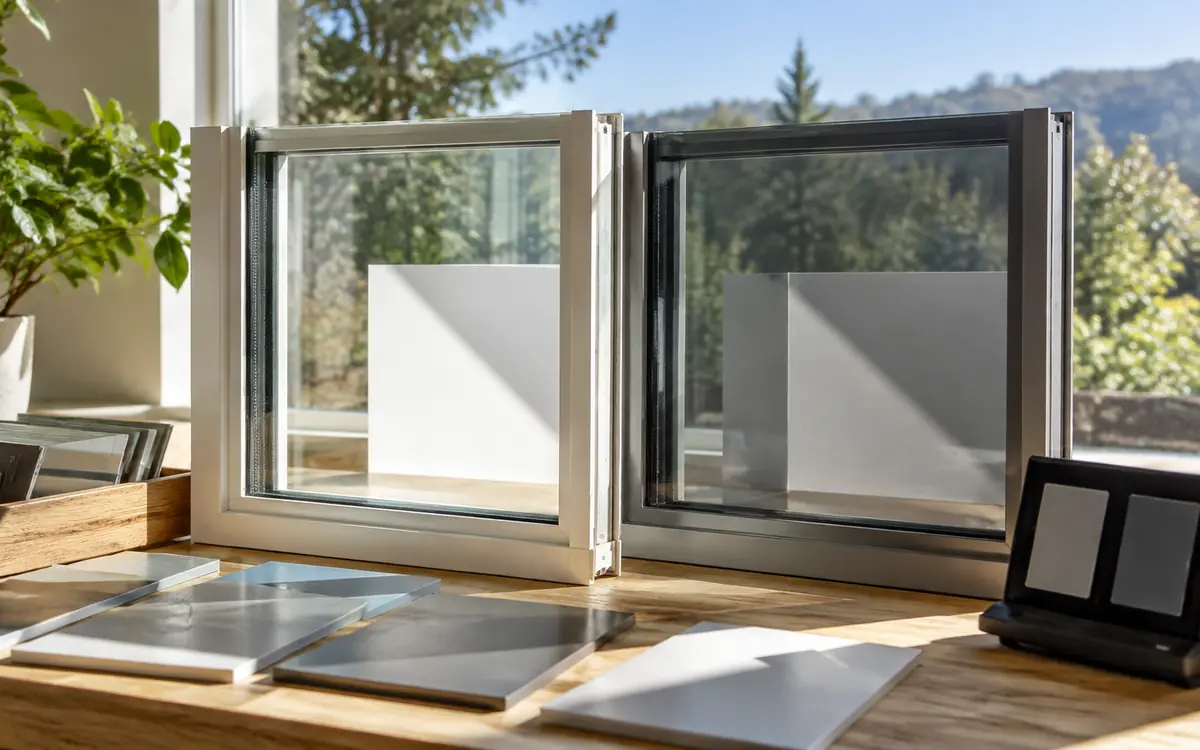
Low-E and tint are not mutually exclusive
A tinted pane can also be part of an insulated unit with a Low-E coating. That is why “Low-E versus tint” is not always a true either-or decision. The complete product (glass layers, coating, spacer, gas fill, frame, and installation) determines the published whole-window ratings and the finished appearance.
When comparing proposals, ask for the manufacturer, product line, glass package, NFRC values, and sample. If one proposal says only “Low-E” or “energy efficient,” there is not enough information for an apples-to-apples comparison.
How to choose for Sacramento and Placer County
Strong summer sun is common across the Sacramento Valley, but one glass package does not fit every opening. A west-facing family room in Sacramento can receive intense afternoon exposure. A shaded north-facing window in Rocklin may need less solar control and benefit from higher visible light. Foothill trees, roof overhangs, neighboring buildings, and exterior screens can change the exposure again.
Map the sun by elevation
Identify windows that receive direct afternoon sun, rooms that overheat, and areas where glare interrupts television or computer use. Compare those with shaded rooms where daylight is more important. Selecting by elevation can produce a better result than choosing the darkest glass for the entire house.
Decide how much color change is acceptable
Look through samples from inside and outside. Check them in direct sun and open shade, ideally near the time of day when the room has a problem. Neutral Low-E glass can still have subtle color or reflectance, while tint can alter interior finishes and the exterior appearance.
Compare the entire window, not the center of glass
Use NFRC whole-product ratings when available. Frame material, frame area, insulated-glass construction, and spacers all contribute to performance. Proper sizing, flashing, sealing, and installation also matter; our window installation service covers the product and installation details together.
A practical decision guide
| Priority | What to compare | Questions to ask |
|---|---|---|
| Reduce solar heat | Lower whole-window SHGC | What is the NFRC SHGC for this exact size and configuration? |
| Keep rooms bright | Higher VT at the SHGC you need | Can I view a full-size sample in sun and shade? |
| Reduce glare | VT, tint color, reflectance, and room orientation | Will this change screen visibility or interior color? |
| Maintain a neutral view | Glass color and reflectance from both sides | Does the coating create a noticeable hue at different angles? |
| Compare overall thermal performance | U-factor together with SHGC | Are these whole-window ratings from the same label? |
What not to assume from a window quote
- Do not assume darker means better. Appearance is not a substitute for rated SHGC and VT.
- Do not assume every Low-E coating is the same. Coating type, placement, and glass package affect the result.
- Do not assume a published energy-savings percentage applies to your home. Results depend on the existing windows, orientation, shade, air leakage, HVAC use, and occupant behavior.
- Do not ignore code and safety glazing. Locations near doors, floors, tubs, and other hazardous areas can require safety glass independent of solar-control goals.
If you are still comparing frame styles and operating types, read our guide to replacement window types for Rocklin homes. For a broader look at project planning, see our Placer County window installation guide. For pricing, see our window replacement cost guide for Rocklin, Roseville and Placer County.
Questions to bring to a window consultation
- What are the whole-window SHGC, VT, and U-factor for this exact product?
- Is the glass Low-E, tinted, or both?
- How will the glass look from indoors and outdoors in direct sun?
- Would different elevations benefit from different glass packages?
- Are tempered or other safety-glazing requirements relevant to any openings?
- Can the proposal list the product line and glass package rather than a generic efficiency label?
Innovative Windows & Glass serves homeowners from its Rocklin showroom across Placer County and the Sacramento area. We install replacement windows and can help compare glass packages against the orientation, shade, view, and daylight priorities of the home. Start with the online estimate or request an on-site measure before selecting a final specification.
Frequently asked questions
Is Low-E glass always clear?
No. Low-E coatings can have subtle color and reflectance, and formulations differ. Review a physical sample and the product’s VT and exterior appearance before choosing.
Do tinted windows block more heat than Low-E glass?
Not necessarily. Compare the whole-window SHGC for the exact products. Tint and Low-E use different methods, and either can be combined with other glass features.
What SHGC is best for a Sacramento-area home?
There is no single number for every opening. Climate matters, but so do orientation, exterior shade, room use, view, and daylight preferences. Compare code-compliant products and evaluate each elevation with a window professional.
Will Low-E or tinted glass lower my utility bill?
Either may reduce unwanted solar heat when correctly selected, but a specific savings result cannot be promised from the glass label alone. Existing window condition, home design, air leakage, HVAC operation, weather, and household habits all affect energy use.
Ready to price your project?
Ballpark in 60 seconds. Free precise measure when it looks right.
10 year in-house install guarantee. C-17 Lic #1061832.
Related reading