
Guides

Key takeaways
- Find the moisture first: room-side droplets, outside dew and between-pane fog call for different responses.
- Indoor condensation often calls for humidity and ventilation checks, not an automatic window order.
- Moisture trapped between sealed panes warrants a glass assessment; a suitable frame may be retained.
- Water entering around trim during rain may be a leak, not ordinary glass condensation.
Condensation on windows does not automatically mean you need new windows. First find the moisture: on the room-facing glass, on the outdoor surface, or trapped between the panes. Indoor droplets usually call for a humidity and airflow check. Outside morning dew can be normal. Moisture inside a sealed dual-pane unit points toward a glass-seal problem that needs assessment.
For homeowners in Rocklin, Roseville, Sacramento and the Placer County foothills, November is a useful time to make that distinction before ordering glass or planning a whole-house replacement. This guide explains what you can check safely, when a repair may be enough, and which details to bring to a consultation.
Quick answer: where is the moisture?
Andersen's window condensation guide distinguishes these three locations. Use the location as a starting point, not a diagnosis from a photograph alone.
| Location | What it can mean | Next step |
|---|---|---|
| Room-facing surface | Indoor moisture condensing on cold glass | Dry the sill, measure humidity, review exhaust ventilation and airflow |
| Outdoor surface | Dew when exterior glass is below the outdoor dew point | Observe whether it clears as conditions change; no replacement decision from dew alone |
| Between sealed panes | Possible failed insulated-glass seal | Request a glass assessment and ask whether the existing frame can stay |
| Trim or wall during rain | Possible water entry, not simply condensation | Record the location and arrange a leak assessment |
A safe two-surface check
- Start indoors. Use a clean soft cloth to wipe a small area of glass. If the droplets disappear there, at least some of the moisture is on the room side.
- Check outside only from a safe position. If the exterior surface is accessible from the ground, see whether that surface is wet too. Do not climb, lean out of an opening, remove a sash, or reach over a balcony to perform this check.
- Look again through both dry surfaces. Haze that remains beyond them may be inside the insulated glass. Reflections, dirt and glass coatings can make the location hard to judge, so ask for an inspection if uncertain.
- Record the pattern. Note the room, time, weather, and whether the haze clears later. Take one full-window photo and one close-up, without dismantling the window.
Droplets may come and go as temperatures change. A dry afternoon does not prove a sealed unit is sound, and a wet morning does not prove it has failed.
Inside condensation: control moisture before buying windows
Condensation forms when a surface is cold enough for water vapor in the surrounding air to become liquid. Cooking, showering, laundry and everyday occupancy add indoor moisture. Glass is often colder than nearby interior surfaces, so it can reveal a moisture problem first. Andersen's guidance recommends reducing indoor humidity and allowing air to reach the glass.
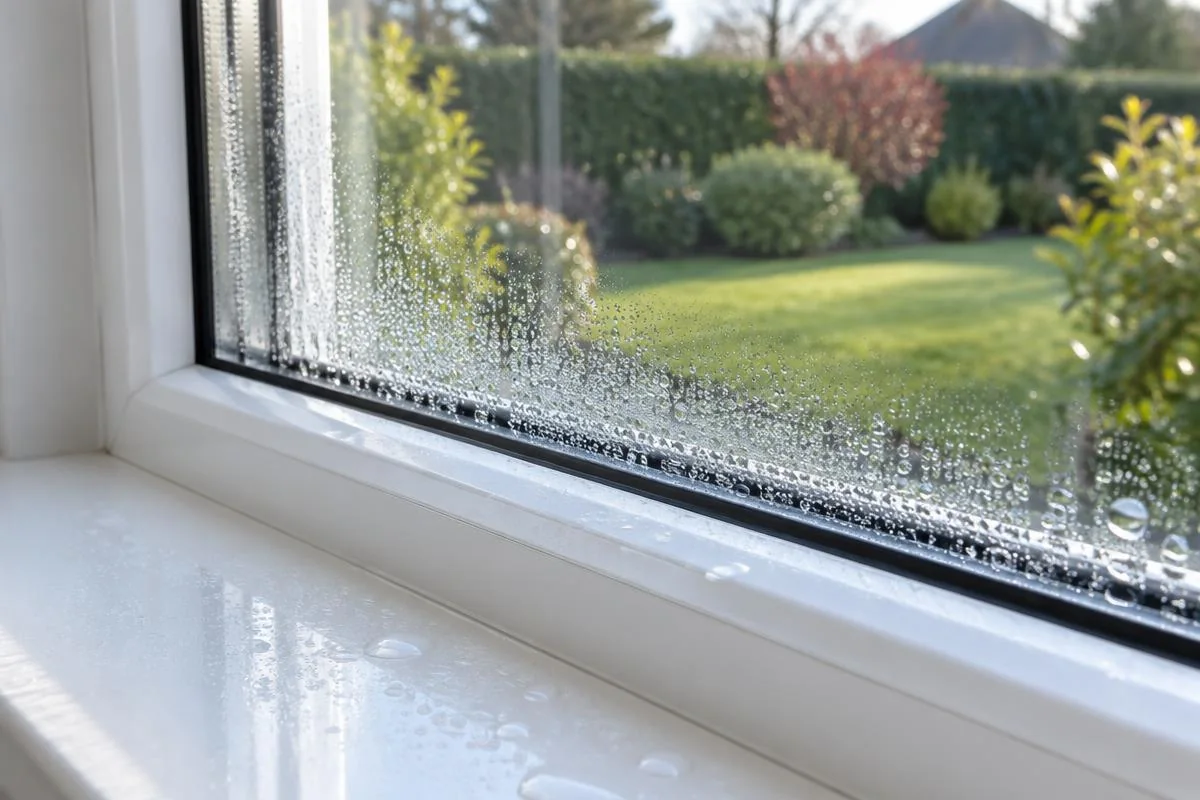
- Wipe up standing water promptly so it does not sit on wood, paint or surrounding finishes.
- Use bathroom exhaust during showers and an externally vented kitchen hood while cooking. A recirculating hood is not the same as exhausting moisture outdoors.
- Open blinds or drapes during the day to let room air reach the glass, while keeping heating outlets unobstructed.
- Check humidifier settings and avoid adding moisture when indoor humidity is already high.
- Use a hygrometer to measure relative humidity rather than guessing from how the room feels.
- If moisture remains high, discuss ventilation or dehumidification with an HVAC professional. Do not modify gas appliances or ventilation equipment yourself.
The EPA's moisture-control guidance recommends indoor relative humidity below 60 percent, ideally between 30 and 50 percent. Andersen suggests 30 to 35 percent during winter. These are general guidance ranges, not a guarantee that a particular window will stay dry: colder outdoor conditions and colder glass can require a lower indoor moisture level.
If moisture persists at ordinary humidity levels, or one opening behaves very differently from the others, ask a professional to evaluate the window and surrounding construction. Indoor droplets alone neither prove nor rule out a separate window defect.
Outside condensation: morning dew is not a failed seal
Milgard explains exterior condensation as the same process that puts dew on grass or a parked car. The outside glass can cool below the outdoor dew point. Insulating glass can reduce the indoor heat reaching that outer pane, so even a newer window can have exterior dew.
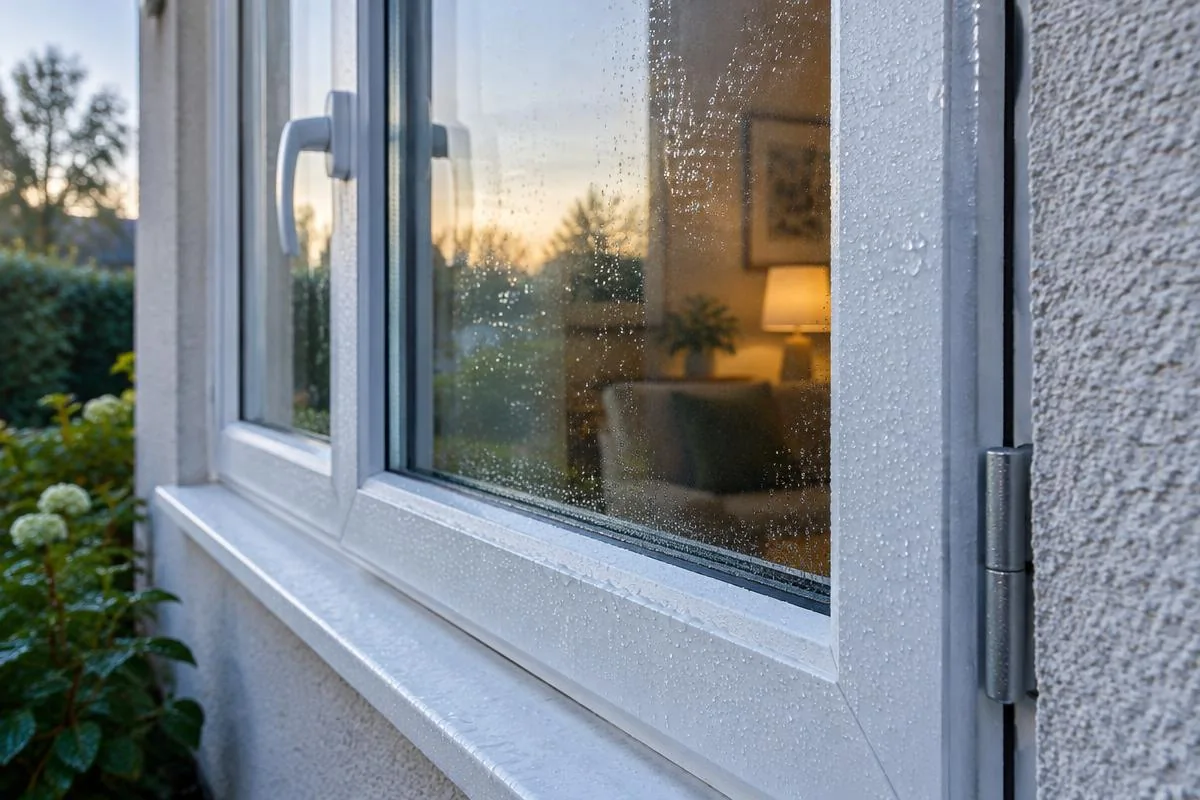
Observe whether the moisture dries as the sun, temperature or airflow changes. Do not drill the glass or cover drainage openings to stop dew. Exterior droplets alone are not a reason to replace the window, and they do not establish a particular energy rating or utility-bill savings.
Between-pane fog: when glass-only repair may fit
A sealed insulated glass unit, often called an IGU, contains separate panes with a sealed space between them. Andersen identifies moisture in that space as a sign of seal failure. Cleaning the exposed surfaces or changing room humidity will not restore that sealed assembly.
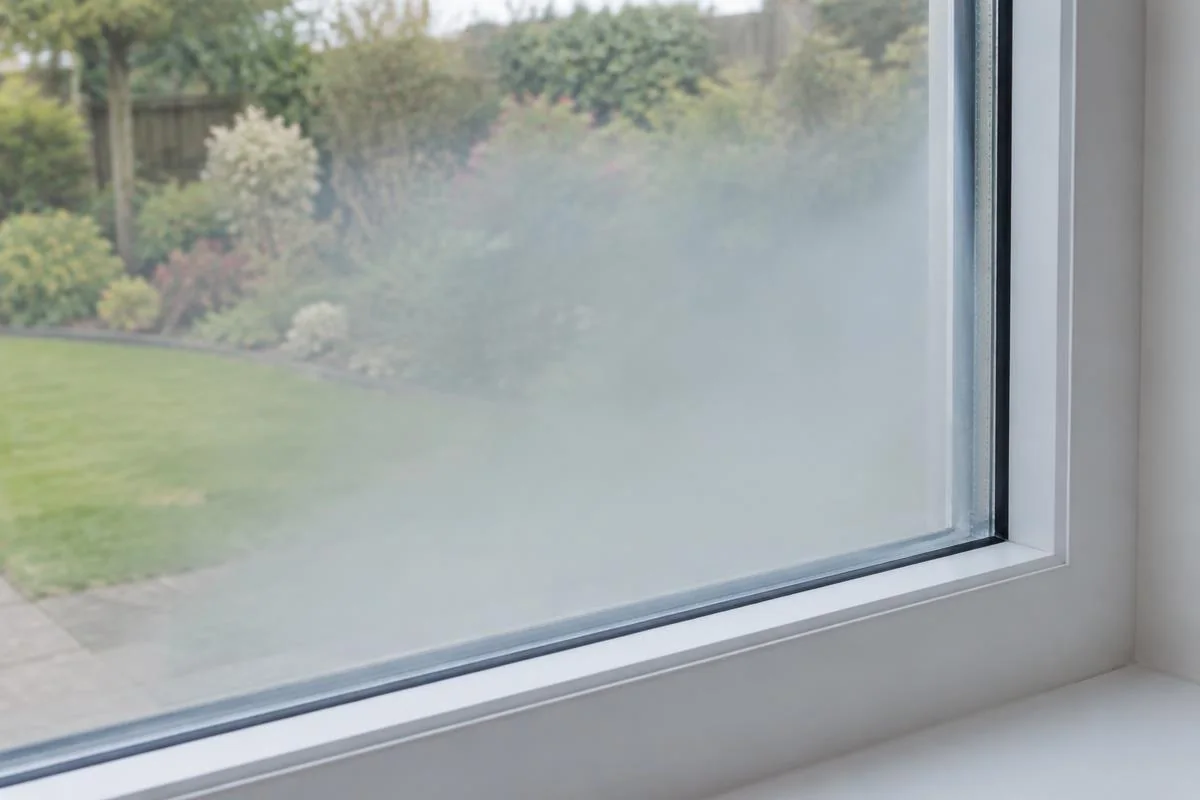
That does not automatically mean removing the entire window frame. Innovative Windows & Glass offers window repair and failed dual-pane seal service and glass repair. If the frame and sash are suitable, replacing the insulated glass may address the failed unit while preserving the existing opening. The team needs to assess the glazing system, condition and measurements before confirming the scope.
A glass specification should consider the existing pane thickness, spacer, coating, appearance and any safety-glazing requirements. Ask how the replacement will match adjacent units. If you are comparing glass packages, our guide to Low-E glass versus tinted windows explains solar heat gain and visible light as separate choices.
Repair, replace, or investigate a leak?
- Moisture only on accessible glass: start with humidity, ventilation and observation. Replacement is not the first conclusion.
- Fog inside one sealed unit, sound surrounding window: ask for a glass-only repair assessment.
- Fog plus deteriorated frame, poor operation or repeated surrounding water damage: compare a repair scope with complete window replacement. Replacing glass will not correct rot, drainage or flashing defects.
- Water entering during rain: investigate the water path. Do not assume a dehumidifier or new glass will fix it.
- Multiple aging openings with separate comfort and operation problems: compare an itemized replacement proposal with targeted repairs. Our Rocklin and Roseville window replacement cost guide helps organize the budget questions.
EPA advises addressing leaks and water damage promptly. Repeated wet finishes, peeling paint, soft trim or suspected mold deserve attention to the moisture source, not simply a cosmetic patch.
What Rocklin and Sacramento homeowners should record
Do not diagnose by ZIP code alone. A shaded opening in Rocklin, a kitchen window in Sacramento and a foothill bedroom in Placer County can have different glass temperatures, ventilation and moisture loads. The same checks apply in Roseville, Lincoln, Loomis and Granite Bay.
For a more useful consultation, gather:
- The affected rooms and whether one window or several are involved.
- Whether the moisture wipes off indoors, outdoors, or neither surface.
- The time and conditions: after showers, overnight, after rain, or throughout the day.
- Indoor humidity readings and any humidifier use.
- A full-opening photo, a glass close-up and any water staining around the trim.
- The manufacturer label or etched glass marking if easily visible. Do not remove parts to find it.
Innovative Windows & Glass serves the region from its Rocklin showroom at 4320 Anthony Ct, Suite 14. Its published services include window installation, glass replacement and hardware repair, with Andersen, Milgard, Anlin, Sierra Pacific and All Weather among its window brands. The company holds C-17 license #1061832. This guide is practical preparation for an inspection, not a claim that a particular condition has been diagnosed remotely.
For a window or glass assessment, contact the team or start an estimate. Explain where the moisture appears so the request can focus on humidity, a sealed-glass repair, or the broader opening rather than assuming every foggy window needs replacement.
Frequently asked questions
Does condensation mean my windows need replacing?
Not by itself. Room-side moisture often points to humidity meeting cold glass, and outside dew can be normal. Moisture trapped between sealed panes, damaged frames, or recurring leaks needs a professional assessment.
How can I tell whether fog is between the panes?
Wipe the indoor glass with a soft cloth, then check the outside only if it is safely accessible from the ground. If haze remains beyond both dry surfaces, an insulated-glass seal problem is possible. A technician can confirm it.
What indoor humidity should I aim for in winter?
EPA recommends keeping indoor relative humidity below 60 percent, ideally 30 to 50 percent, for moisture control. Andersen suggests 30 to 35 percent in winter. The level that avoids window condensation also depends on outdoor temperature and the glass surface temperature.
Can you replace foggy glass without replacing the frame?
Often, when the existing frame and sash are suitable. Innovative Windows & Glass offers failed dual-pane seal and glass repair. An inspection determines whether an insulated glass replacement, sash work, or a complete window replacement fits the condition.
Why do new windows sometimes have dew outside?
The outside glass can cool below the outdoor dew point, allowing water droplets to form. Milgard explains that insulating glass can limit heat reaching that outer surface. Exterior dew alone is not evidence of a failed seal or a measured energy-savings result.
Is water around the frame after rain the same as condensation?
Not necessarily. Water entering at trim, the frame, or the wall during rain may indicate a drainage, flashing, or other leak problem. Record where and when it appears and arrange an assessment rather than assuming it is ordinary glass condensation.
Sources and further reading
Technical guidance checked November 15, 2026. The manufacturer sources explain the condensation mechanism; EPA provides household moisture guidance. Product-specific repair options still require inspection.
Ready to price your project?
Ballpark in 60 seconds. Free precise measure when it looks right.
10 year in-house install guarantee. C-17 Lic #1061832.
Related reading